


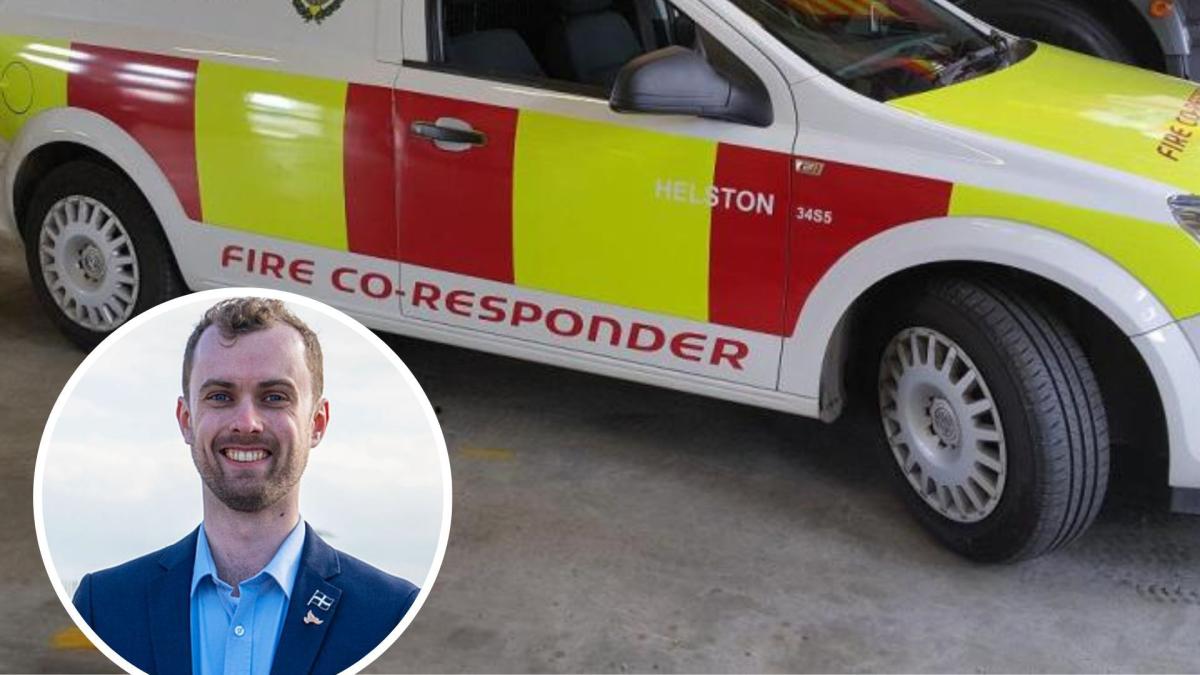


An emergency meeting of Cornwall councillors has been held over the decision to phase out the fire co-responder service over the next 12 months.
Last week South West Ambulance Service Trust’s announced it was ending its co-responder partnership with Cornwall Fire and Rescue Service.
In its place, it said it would be relying on and building its Community First Responder partnership, which now has more than 600 volunteers across the South West.
The ambulance trust says phasing out the partnership will save money on mobilisation costs, and the savings will be used to develop the community responder scheme further.
You can read more about that here: Lifesaving fire co-responder service to be phased out of Cornwall in 12 months

They have now called for greater “clarity and accountability” during the transition process, as well as “a solution which prioritises the safety and well-being of those who rely on these services most.”
A joint statement from councillors, shared by Mr Gow, reads: “We fully recognise the dedication and professionalism of community volunteer responders, who play a vital role in delivering emergency care and achieving positive patient outcomes.
“While we understand the financial and operational rationale behind expanding this model, it is essential that this transition does not come at the expense of our rural communities.
Cornwall’s elected representatives, at parish, town and county-wide levels, require clear assurances through this process.
“Cornwall councillors have requested that SWASFT provide monthly updates to councillors on the recruitment and deployment of community volunteers during the transition period.”
The information called for by councillors includes:
- The number of volunteers trained for the scheme.
- The number currently available to respond.
- The retention rate of community first responders.
- The volume of emergency calls per area.
- The proportion of calls responded to by community first responders.
- The proportion of calls responded to by fire co-responders – why they were called, and whether their response met expected standards.
The update goes on to add: “Furthermore, we insist that this data accurately reflects the realities of rural areas, rather than being skewed by figures from higher-population regions.
“Our emergency services work best when they work together; whether through joint response efforts, shared training facilities, or a blended approach that combines the community volunteers and co-responders.
“This is not about replacing one service with another; it is about ensuring resilience, collaboration, and the continued provision of life-saving support for Cornwall’s most isolated communities.
“We will continue to press for clarity, accountability and a solution which prioritises the safety and well-being of those who rely on these services most.”
Andrew George, MP for St Ives and West Cornwall, and a Health Select Committee member, has also written to the Trust’s CEO, Dr John Martin, urging them to “reconsider before it’s too late.”
READ NEXT:
- Lifesaving fire co-responder service to be phased out of Cornwall in 12 months
- MP writes to ambulance trust CEO warning 'countless lives could be lost'
- 'Lives will be lost': Anger over 'devastating' move to end fire co-responders
- ‘They see lives saved’: Petition launched to save Cornwall’s Fire Co-Responders
A spokesperson for the South Western Ambulance Service NHS Foundation Trust, said: “We continually review our 999 response model to ensure we’re delivering a high level of patient care.
“In recent years, we have been developing and strengthening our Community First Responder (CFR) volunteering model, and now have over 600 volunteer CFRs across the South West. They play a vital role in helping us to respond to 999 calls and deliver emergency care to patients within their local community, often ahead of an ambulance arriving on the scene.
“This development means we will be phasing out the Fire Co-Responder role that the Trust has provided in collaboration with Fire and Rescue Services, and we would like to offer our thanks and gratitude to all Fire Co-Responders who have supported the Trust, by providing dedicated patient care, and who are now working with us to manage the change.
“CFRs receive an enhanced level of clinical training to help them respond to patients. CFRs can, with clinical support from the Trust, administer pain relief and discharge patients at the scene where an onward conveyance to hospital is not the most appropriate next step for them.
“The cost comparator between a Fire Co-Responder and a SWASFT Community First Responder is significant, so as part of our responsibility to provide the best possible care to patients, while meeting national expectations for efficiency and value for money, we are investing in increasing volunteers across the South West.
“We are repurposing the finances to ensure we can provide increased availability within the community through our established CFR scheme.
“As part of the transition, we have invited Fire Co-Responders to train to become CFRs, so they can acquire new skills and continue to help support their local community in a medical emergency.
“We are also extremely grateful to the Fire and Rescue Services who have volunteered space on their sites for us to undertake local recruitment and training.”


Share